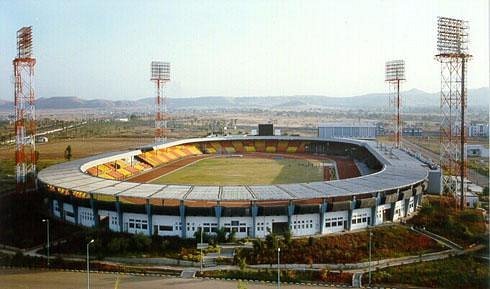
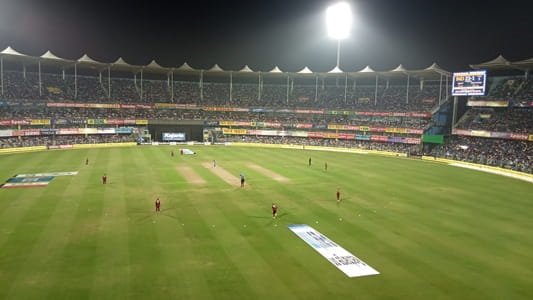
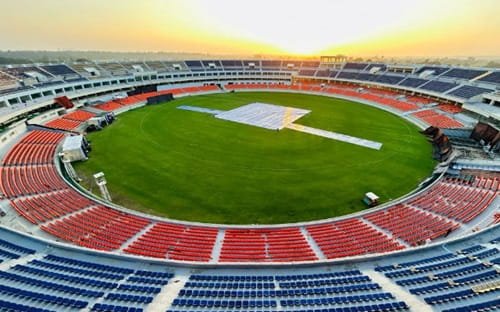
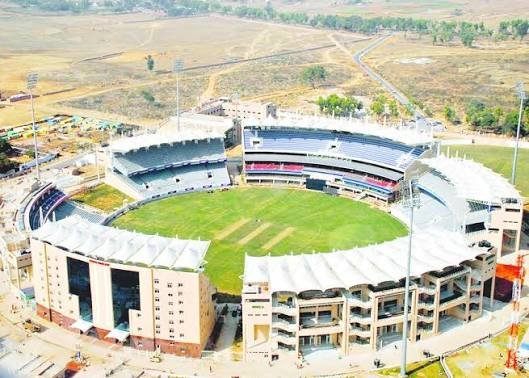
JSCA International Cricket Stadium in Ranchi is the ground MS Dhoni calls home, built specifically to end a bitter dispute with Tata Steel over international match allocation at the older Keenan Stadium. Flanked by two hills — the East and West Hills — this Jharkhand State Cricket Association venue has an architectural quirk few Indian stadiums can claim: no shadow ever falls across its nine pitches before 4:45 pm, even on the year’s shortest day. Here’s a complete breakdown of its location, capacity, and facilities.
| Quick Facts | Details |
| Full name | JSCA International Stadium Complex |
| Location | Dhurwa, Ranchi, Jharkhand |
| Established | 2011; inaugurated January 2013 |
| Seating capacity | 39,000–50,000 (sources vary) |
| Owner/Operator | Jharkhand State Cricket Association |
| Architect | Kothari Associates Pvt. Ltd. |
| Home team | Jharkhand cricket team |
| Ends | M.S. Dhoni Pavilion, Amitabh Choudhary Pavilion |
| Corporate boxes | 76 |
| Notable feature | Flanked by East and West Hills; nine practice pitches |
Where Is JSCA International Cricket Stadium Located?
The stadium sits in Dhurwa, within the Heavy Engineering Corporation (HEC) premises in Ranchi, Jharkhand’s capital city. Its location between two natural hills, locally known as the East and West Hills, gives it a genuinely distinctive visual identity — few Indian cricket grounds are framed by this kind of topography, and it directly shapes the stadium’s celebrated shadow-free design.
Reaching the venue is manageable given Ranchi’s regional connectivity:
- By air: Birsa Munda Airport connects Ranchi to major Indian cities, keeping the stadium accessible for visiting teams and travelling fans.
- By rail: Ranchi Junction serves as the city’s main railway hub, linking Jharkhand to the broader Eastern and Central Indian rail network.
- By road: The stadium’s Dhurwa location, within HEC premises, is reachable via Ranchi’s local road network, with autos and cabs covering the final stretch from the city centre.
How Many Spectators Can It Hold?
Capacity figures for JSCA International Stadium vary meaningfully across sources, ranging from around 39,000 to 50,000. The lower figures, often cited around 39,133, appear to reflect actual seated configuration for regular matches, while the higher 50,000 figure is frequently used when describing the stadium’s overall architectural scale and design capacity.
A few things worth understanding about its scale and design:
- The stadium was built with nine full pitches, an unusually high number that supports extensive practice and multiple concurrent match preparations.
- Its unique architectural orientation ensures no shadow falls across the playing surface before 4:45 pm, even during the shortest days of the year, a genuinely rare engineering consideration for an outdoor cricket ground.
- Boundary dimensions meet international standards, with the shortest boundary measuring approximately 59.43 metres and straight boundaries set at a minimum of 64 metres.
Facilities Inside the Stadium
JSCA International Stadium Complex was designed to compete with India’s best modern cricket venues, and its facility list reflects that ambition.
For players and teams:
- Nine full-sized pitches supporting extensive training and match rotation
- Facilities named after Jharkhand’s own cricketing legend, with ends designated as M.S. Dhoni Pavilion and Amitabh Choudhary Pavilion
- Floodlights enabling day-night matches across all formats
For corporate and premium guests:
- 76 corporate hospitality boxes offering premium match-day viewing
- Recreational amenities extending beyond core cricket facilities within the broader complex
Architectural highlights:
- A design specifically oriented to avoid pitch shadowing during play, a rare and deliberate engineering feature
- Natural hill backdrops on both the East and West sides, giving the stadium genuine visual distinction among Indian venues
Why Was This Stadium Built?
The stadium’s origin story is genuinely significant to understanding its purpose. Before JSCA International Stadium existed, Jharkhand’s international cricket matches were allocated to Keenan Stadium, a venue owned by Tata Steel. A dispute over match allocation between the Jharkhand State Cricket Association and Tata Steel led directly to the decision to build an entirely new, independently controlled venue. That decision resulted in a stadium that not only resolved the allocation dispute but also gave Jharkhand a genuinely world-class facility to call its own — one closely associated with the state’s most famous cricketing export, MS Dhoni.
Matches and Cricketing History
Since its January 2013 inauguration with an India-England ODI, the stadium has built a substantial international résumé. It hosted its first Test in March 2017, another India-Australia fixture, with its most recent Test coming in February 2024 against England. On the white-ball side, it has hosted regular ODIs and T20Is, including women’s internationals in February 2016. The venue has also featured in IPL history, having hosted seven IPL matches, with Chennai Super Kings previously using it as a home ground given Dhoni’s deep ties to both Jharkhand and the franchise.
A Stadium Tied to Jharkhand’s Cricketing Identity
What makes JSCA International Stadium genuinely significant beyond its architecture is its role in Jharkhand’s broader cricketing story. The state has produced several capped Indian players, including Dhoni himself, Varun Aaron, Shahbaz Nadeem, and more recently Ishan Kishan. Having a stadium of this calibre gives Jharkhand’s domestic setup, including both men’s and women’s teams, a genuine home ground capable of hosting Ranji Trophy, Vijay Hazare Trophy, and other major domestic tournaments alongside international fixtures.
FAQs
Q1. Why was JSCA International Stadium built instead of continuing to use Keenan Stadium?
A dispute between Jharkhand State Cricket Association and Tata Steel over international match allocation at Keenan Stadium led to the construction of this new, independently operated venue.
Q2. What makes the stadium’s design architecturally unique?
Its orientation ensures no shadow falls across the nine playing pitches before 4:45 pm, even on the shortest day of the year, a rare engineering feature among cricket grounds.
Q3. Which IPL team has used JSCA International Stadium as a home ground?
Chennai Super Kings previously used the venue as a home ground, largely due to MS Dhoni’s strong association with both the franchise and Jharkhand cricket.
Q4. Why do capacity figures for this stadium differ across sources?
Seated configuration is often cited around 39,000-39,133, while the stadium’s full architectural design capacity is frequently listed at 50,000, causing the discrepancy across sources.