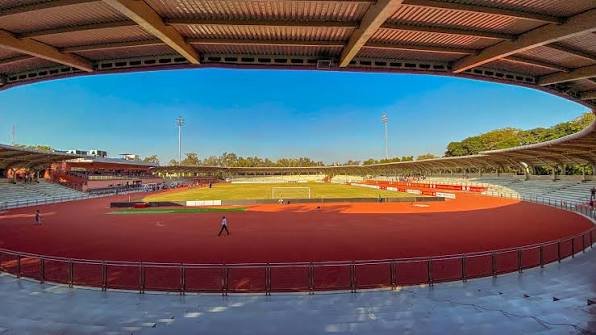
Major Dhyan Chand Stadium New Delhi was originally meant to be a garden. Edwin Lutyens, the architect who designed New Delhi itself, planned this exact spot to offer an unobstructed view of the historic Purana Quila, sitting perpendicular to the axis running from Rashtrapati Bhavan through Rajpath to India Gate. His garden plans were overruled, and in 1933 the Maharaja of Bhavnagar gifted Delhi something else entirely — a stadium that would eventually become field hockey’s spiritual home in India.
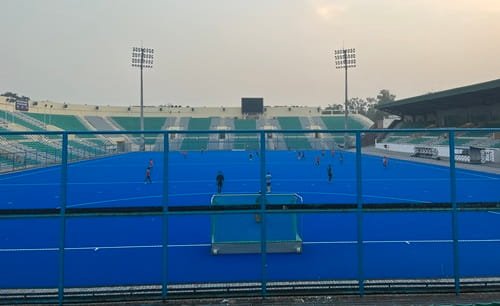
Quick Facts
| Detail | Information |
| Full name | Major Dhyan Chand National Stadium |
| Former names | Irwin Amphitheatre, National Stadium |
| Location | New Delhi, near India Gate |
| Built | 1933; rebuilt 2010 |
| Owner/Operator | Sports Authority of India |
| Architect | Anthony S. DeMillo |
| Seating capacity | 16,200 |
| Main pitch seating | ~16,200 |
| Second pitch seating | 900 permanent, 1,600 temporary |
| Nearest metro | Pragati Maidan |
| Renamed after Dhyan Chand | 2002 |
Locating the Stadium Near Delhi’s Historic Core
The stadium sits within one of New Delhi’s most architecturally significant zones, along the ceremonial axis connecting Rashtrapati Bhavan, Rajpath, and India Gate, with the historic Purana Quila visible in the backdrop. This wasn’t accidental positioning — the site was deliberately chosen as part of Lutyens’ original vision for New Delhi’s grand civic layout, even though his specific garden plans for the location were ultimately set aside.
Reaching the stadium is genuinely convenient given its central location:
- Pragati Maidan metro station sits closest to the venue, making it easily accessible via Delhi’s metro network.
- Its proximity to India Gate and Purana Quila Road means visitors can easily combine a stadium visit with broader sightseeing across this historically dense part of the capital.
- Central Delhi’s well-established road network keeps the stadium reachable via local transport without requiring specialised arrangements.
Understanding the Stadium’s Capacity
Major Dhyan Chand Stadium’s seating capacity stands consistently at 16,200, a figure that appears reliably across Wikipedia and most current reference sources. The stadium’s structure includes two distinct competitive pitches, each with its own seating arrangement contributing to that overall figure.
A few things worth understanding about how that capacity breaks down:
- The main field carries approximately 16,200 seats, forming the bulk of the stadium’s total capacity.
- A second pitch, located outside the primary arena, adds 900 permanent seats with provisions for an additional 1,600 temporary seats during high-demand events.
- Despite being nearly a century old in origin, the stadium’s 2010 rebuild brought its capacity and infrastructure fully up to modern international hockey standards.
What the Stadium Offers Today
The 2010 renovation transformed Major Dhyan Chand Stadium into a genuinely world-class hockey venue, and its facility list reflects that comprehensive modernisation.
- Two competitive pitches equipped with foldable floodlight towers providing 2,200 lux illumination, enabling high-definition television broadcast standards
- Change rooms and relaxation lounges for players, alongside a dedicated VVIP lounge
- Full air conditioning throughout the venue, with lifts installed for accessibility
- Barrier-free provisions for physically challenged athletes and spectators
- Dual power supply from two separate electrical grids, backed by generator sets and uninterrupted battery power supply
- Sports facilities extending beyond hockey to include kabaddi, tennis, swimming, cricket, and a multi-gym
- An ongoing squash court construction project, awarded to NBCC, adding further sporting infrastructure
From Irwin Amphitheatre to National Stadium
The stadium’s naming history genuinely traces India’s own political evolution. Built in 1933 as the Irwin Amphitheatre, originally conceived as a multipurpose venue, it was renamed National Stadium ahead of the 1951 Asian Games — a rebranding that reflected India’s newly independent status shaping its civic and sporting institutions. The Major Dhyan Chand name, honouring India’s legendary hockey player often called the “Wizard” for his extraordinary stick skills, was added in 2002, decades after the stadium had already established itself as the country’s premier hockey venue.
India’s Spiritual Home of Hockey
What genuinely distinguishes Major Dhyan Chand Stadium among Indian sporting venues is its deep, sustained connection to field hockey specifically. When India hosted Germany in a two-match Test series here in October 2024, it marked international hockey’s return to the capital after a ten-year gap — and the significance wasn’t lost on the players involved. India’s coach Craig Fulton made his own international playing debut at this exact stadium back in 1995, while captain Harmanpreet Singh developed his hockey skills here before playing his first match at the venue as national captain. That kind of generational continuity, connecting current players to the stadium’s decades-long hockey legacy, reinforces why it’s genuinely regarded as the sport’s spiritual home in India.
A Multi-Sport Facility Beyond Hockey
While hockey remains the stadium’s defining identity, Sports Authority of India’s management has kept the venue genuinely multi-purpose. Kabaddi, tennis, swimming, and cricket all have dedicated facilities within the complex, alongside a functioning multi-gym for athlete conditioning. This breadth ensures the stadium stays consistently active throughout the year, rather than sitting dormant between major international hockey fixtures — a genuinely practical use of the venue’s substantial infrastructure investment.
Honouring Hockey’s Greatest Indian Legend
The 2002 addition of Dhyan Chand’s name carries genuine weight within Indian sporting history. Widely regarded as one of the greatest hockey players ever, Dhyan Chand led India to three consecutive Olympic gold medals between 1928 and 1936, scoring goals with a stick control that opponents and commentators of his era genuinely struggled to explain. Attaching his name to India’s most significant hockey venue connects the stadium directly to the sport’s golden era in Indian sporting history, giving current and future generations of players a physical link to that legacy every time they step onto the pitch.
FAQs
Q1. Why was the stadium originally called Irwin Amphitheatre?
It was built in 1933 as a multipurpose venue named Irwin Amphitheatre, later renamed National Stadium before the 1951 Asian Games, with Dhyan Chand’s name added in 2002.
Q2. How significant is Major Dhyan Chand Stadium for current Indian hockey players?
Genuinely significant — captain Harmanpreet Singh developed his skills here, and coach Craig Fulton made his own international debut at this exact venue in 1995.
Q3. What sports besides hockey can be played at this stadium?
The complex includes facilities for kabaddi, tennis, swimming, cricket, and a multi-gym, with a squash court currently under construction as an additional facility.
Q4. How do I reach Major Dhyan Chand Stadium using Delhi Metro?
Pragati Maidan metro station is the closest option, making the venue easily accessible given its central location near India Gate and Purana Quila.