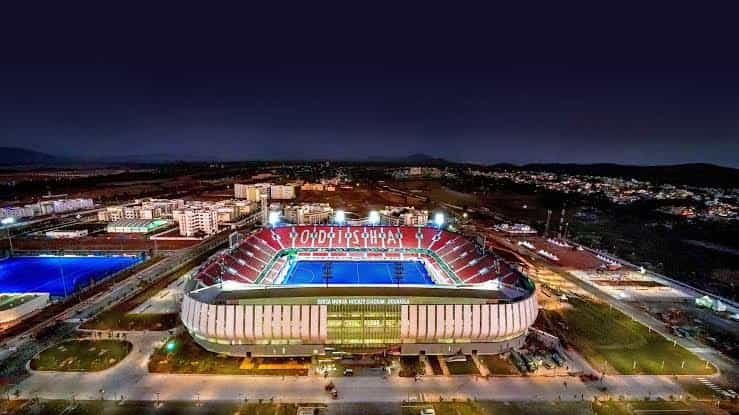
Birsa Munda International Hockey Stadium holds a Guinness World Record most stadiums only dream about — the largest fully-seated hockey arena on the planet. Built in a record 15 months in Rourkela, Odisha, this ground was Chief Minister Naveen Patnaik’s stated “gift to the nation,” rushed into readiness specifically to co-host the 2023 FIH Men’s Hockey World Cup. Named after tribal freedom fighter Birsa Munda, it now stands as both a competitive venue and a symbol of Odisha’s decade-long investment in hockey infrastructure.
Birsa Munda International Hockey Stadium Overview
| Detail | Information |
| Location | Rourkela, Sundargarh district, Odisha |
| Named after | Birsa Munda, 19th-century tribal freedom fighter |
| Owner | Government of Odisha |
| Operator | Department of Sports and Youth Services (DSYS) |
| Opened | 5 January 2023 |
| Construction time | 15 months (record pace) |
| Construction cost | ₹146-260 crore (sources vary) |
| Seating capacity | 20,011-21,800 (Guinness World Record confirmed) |
| Site area | 15-35 acres (sources vary) |
| Surface | Astro-Turf (two pitches) |
| World record | Largest fully-seated hockey stadium, confirmed January 2023 |
Where the Stadium Sits in Rourkela
The stadium occupies land on the campus of Biju Patnaik University of Technology (BPUT) in Rourkela, a city known locally as Odisha’s “Steel City” and industrial hub. Sundargarh district, where Rourkela sits, carries genuine hockey pedigree — it’s produced a remarkable number of national and international hockey players over the decades, making this location choice far from arbitrary.
Getting to the venue involves a few practical considerations:
- Rourkela connects to the wider Odisha rail network, offering reasonable access for domestic and international visitors travelling to major hockey fixtures.
- The stadium sits within an established university campus, giving it institutional infrastructure and road access already built around academic and civic activity in the area.
- Six parking lots operate within a 100-metre radius of the stadium itself, a genuinely thoughtful design choice for a venue expecting large tournament crowds.
- Local transport within Rourkela connects reasonably well to the stadium complex, with visitors noting the venue remains accessible despite being outside India’s traditional metro or tier-1 city circuit.
The Capacity Number That Made World Records
Figures for Birsa Munda’s exact seating capacity have shifted slightly across different reporting periods, ranging from an initial 20,011 to a later confirmed 21,800. Both numbers earned the stadium recognition — Guinness World Records officially certified it as the largest fully-seated hockey arena in the world on January 29, 2023, and FIH President Tayyab Ikram later reaffirmed the higher 21,800 figure as putting the debate over its “world’s largest” status to rest entirely.
A few things worth understanding about how this scale came together:
- Over 1,000 workers were involved in construction, working at a pace that delivered a world-record venue in just 15 months from groundbreaking.
- The stadium features two distinct seating levels, an upper bowl and lower bowl, engineered specifically to maximise both capacity and sightline quality.
- Odisha specifically built this venue because FIH required two host cities for the 2023 Men’s Hockey World Cup, with Rourkela handling 20 of the tournament’s 44 matches while Bhubaneswar’s Kalinga Stadium hosted the remaining 24, including the final.
What the Stadium Offers Players and Fans
Designed to International Hockey Federation and Hockey India standards, Birsa Munda’s facility list reflects genuine ambition beyond just seating numbers.
- Two world-class Astro-Turf pitches, giving the venue capacity for simultaneous training and competitive matches
- Player dressing rooms, sauna facilities, and a dedicated fitness centre supporting elite athlete preparation
- A swimming pool included within the broader training complex
- 225 accommodation rooms built around the stadium complex, specifically housing players and support staff from competing nations during major tournaments
- Clear physical separation between Players, Media, and VIP zones within the West Pavilion, avoiding the logistical confusion common at older multi-purpose venues
- Centrally controlled sports lighting designed to deliver consistent conditions for both day and night matches
- Full accessibility provisions, including dedicated seating for differently-abled spectators in line with harmonised design guidelines
Engineering for Atmosphere, Not Just Capacity
What genuinely distinguishes Birsa Munda from a purely functional sports venue is its parametric design approach, specifically adapted to deliver uninterrupted sightlines from every single seat in the stadium. The facade itself was conceived as a shimmering curved metallic screen, blending vertical solid bands with transparent sections to evoke a genuinely global stadium identity while still rooting the design in Odisha’s cultural context. This wasn’t accidental — organisers wanted a venue that felt world-class on broadcast while also standing as a distinctly Odishan architectural statement.
Honouring a Tribal Freedom Fighter
The stadium’s naming carries deep historical resonance. Birsa Munda was a 19th-century tribal leader and freedom fighter from Khunti, in present-day Jharkhand, remembered for leading resistance against British colonial exploitation of tribal lands and forests. Naming India’s largest hockey stadium after him connects this modern sporting achievement directly to a legacy of indigenous resistance and pride, giving the venue meaning that extends well beyond its role in competitive hockey.
Odisha’s Sustained Hockey Investment
Birsa Munda Stadium didn’t emerge in isolation — it represents the second consecutive time Odisha has hosted the FIH Men’s Hockey World Cup, following the 2018 edition held entirely at Kalinga Stadium in Bhubaneswar. That continuity reflects a deliberate state strategy: rather than treating hockey infrastructure as a one-off event expense, Odisha has built a sustained ecosystem, positioning itself as India’s genuine hockey capital. The stadium continues serving as a training and development base for India’s national team throughout the year, well beyond any single tournament cycle, ensuring the world-record facility doesn’t sit dormant between major competitions.
FAQs
Q1. Is Birsa Munda Stadium really the world’s largest hockey stadium?
Yes, Guinness World Records officially certified it as the largest fully-seated hockey arena globally in January 2023, with capacity later confirmed at 21,800 seats by the FIH president.
Q2. Why was this stadium built specifically in Rourkela?
FIH required two host cities for the 2023 Hockey World Cup, and Sundargarh district, where Rourkela sits, has a strong historical reputation for producing national and international hockey talent.
Q3. How long did it take to build Birsa Munda Stadium?
Construction was completed in a record 15 months, involving over 1,000 workers, to meet the tight deadline ahead of the 2023 FIH Men’s Hockey World Cup.
Q4. Does the stadium still host events after the 2023 World Cup ended?
Yes, it continues functioning as a year-round training and development centre for India’s national hockey team, alongside hosting other major domestic and international fixtures.