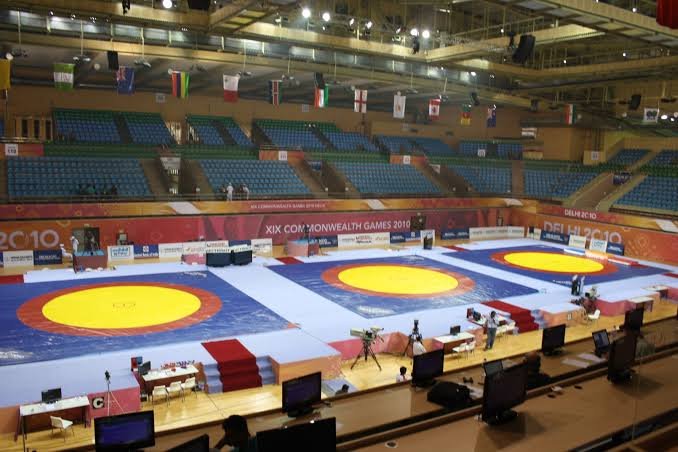
KD Jadhav Wrestling Stadium New Delhi honours a genuinely historic name in Indian sport — Khashaba Dadasaheb Jadhav, the first independent India athlete to win an individual Olympic medal, a bronze in wrestling at the 1952 Helsinki Games. Built specifically for the 2010 Commonwealth Games at a cost of ₹120 crore, this dedicated indoor arena sits within the Indira Gandhi Indoor Stadium complex, giving Delhi a purpose-built home for one of India’s most historically significant Olympic sports.
KD Jadhav Wrestling Stadium Quick Facts
| Detail | Information |
| Also known as | KD Jadhav Indoor Hall |
| Named after | Khashaba Dadasaheb Jadhav (first Indian individual Olympic medallist) |
| Location | IG Indoor Stadium complex, ITO, Vikram Nagar, New Delhi |
| Built for | 2010 Commonwealth Games |
| Inaugurated | April 2010 |
| Construction cost | ₹120 crore |
| Seating capacity | 6,000-6,932 (sources vary) |
| Built-up area | 22,350 square metres |
| Primary sport | Wrestling |
Locating the Stadium in Indraprastha Estate
The stadium sits north of the main Indira Gandhi Indoor Stadium, within the broader Indraprastha Estate complex in eastern New Delhi. This positioning is significant — rather than functioning as a standalone facility, KD Jadhav Wrestling Stadium operates as part of one of India’s largest indoor sporting hubs, giving it access to shared infrastructure and administrative support from the wider complex.
Reaching the venue works well given its central Delhi location:
- ITO, Delhi Gate, and Indraprastha metro stations all sit within reasonable reach of the Indira Gandhi Indoor Stadium complex, making the venue genuinely accessible via Delhi’s metro network.
- DTC buses serve the surrounding area regularly, offering an additional practical transport option.
- Being part of the larger IG Indoor Stadium complex means shared parking and access facilities are already well-established for visitors attending events here.
Understanding the Stadium’s Capacity
Reported capacity for KD Jadhav Wrestling Stadium ranges between 6,000 and 6,932, with most sources converging around the 6,932 figure originally cited at the venue’s 2010 inauguration. This kind of tight variance is typical for purpose-built Commonwealth Games venues, where original construction specifications remain fairly consistent across reference sources.
A few things worth understanding about its scale and purpose:
- The stadium was specifically constructed to host wrestling events for the 2010 Commonwealth Games, reflecting genuine purpose-built design rather than a retrofitted multi-sport venue.
- Its 22,350 square metre built-up area gives the facility substantial physical scale relative to its seating capacity, accommodating training areas and support facilities alongside the competition space.
- Compared to other Delhi indoor venues, this capacity places it in a similar range to Chhatrasal Stadium’s wrestling infrastructure, though KD Jadhav functions as a dedicated indoor arena rather than an open training akhada.
What the Venue Offers
As a Commonwealth Games-standard facility, KD Jadhav Wrestling Stadium was built with genuine attention to both competitive and spectator needs.
- Modern amenities designed to support elite wrestling competition at national and international levels
- Facilities suited to both major competitive events and regular training sessions
- Infrastructure supporting significant crowd attendance during high-profile wrestling tournaments
- Media and broadcast-ready facilities reflecting the venue’s Commonwealth Games origins
- Shared access to the broader Indira Gandhi Indoor Stadium complex’s amenities, given its integrated location within that larger facility
A Tribute to India’s Olympic Wrestling Pioneer
The stadium’s naming carries genuine historical weight for Indian sport. Khashaba Dadasaheb Jadhav’s bronze medal at the 1952 Helsinki Olympics marked the first individual Olympic medal won by independent India — a landmark achievement that predates the country’s now-storied wrestling tradition by decades. Naming Delhi’s dedicated wrestling venue after him connects a purpose-built modern facility directly to the sport’s earliest and most foundational moment in India’s Olympic history, giving the stadium symbolic weight well beyond its role as a competition venue.
Built for a Global Sporting Moment
KD Jadhav Wrestling Stadium’s construction was explicitly tied to Delhi’s hosting of the 2010 Commonwealth Games, part of a broader wave of purpose-built sporting infrastructure the city developed for that event. Alongside venues like the renovated Indira Gandhi Indoor Stadium, Major Dhyan Chand National Stadium, and Delhi University Stadium, KD Jadhav represented Delhi’s investment in giving individual sports genuinely dedicated, world-class facilities rather than repurposing existing multi-sport grounds. That ₹120 crore investment specifically for wrestling reflected the sport’s significant place within India’s competitive sporting identity, particularly given the country’s growing international wrestling success in subsequent years.
Wrestling’s Growing Stature in Indian Sport
Since the stadium’s 2010 opening, Indian wrestling has produced a steady stream of Olympic and Commonwealth Games medals, with athletes training across facilities including Delhi’s Chhatrasal Stadium and dedicated venues like KD Jadhav Wrestling Stadium. Having a purpose-built, Commonwealth Games-standard indoor arena in the national capital gives Indian wrestling genuine competitive infrastructure for hosting national championships and international tournaments, supporting the sport’s continued development well beyond the 2010 Games that originally justified its construction.
FAQs
Q1. Who was Khashaba Dadasaheb Jadhav, and why is the stadium named after him?
He was the first independent Indian to win an individual Olympic medal, a bronze in wrestling at the 1952 Helsinki Games, making him a foundational figure in India’s Olympic wrestling history.
Q2. Is KD Jadhav Wrestling Stadium a standalone venue or part of a larger complex?
It’s located within the broader Indira Gandhi Indoor Stadium complex in Indraprastha Estate, sharing infrastructure and access facilities with the larger indoor arena.
Q3. How do I reach KD Jadhav Wrestling Stadium using Delhi Metro?
ITO, Delhi Gate, and Indraprastha metro stations are all within reasonable reach of the Indira Gandhi Indoor Stadium complex where the wrestling venue is located.
Q4. Why does the stadium’s capacity figure vary between 6,000 and 6,932?
Most current sources cite the original 2010 inauguration figure of 6,932, though some references round this to a simpler 6,000 for general reporting purposes.