Officially named the Rajiv Gandhi International Cricket Stadium, Dehradun’s cricketing centrepiece has done something few venues manage on debut — win a LEED Gold sustainability certification while still delivering a proper ICC-standard playing experience. Set against the Garhwal Himalayas’ rolling hills, it gave Uttarakhand its first genuinely international-standard sporting facility, and it’s since built a real match résumé despite being barely a decade old. Here’s a complete breakdown of its location, scale, and what it offers.
| Quick Facts | Details |
| Full name | Rajiv Gandhi International Cricket Stadium |
| Also known as | Dehradun International Cricket Stadium |
| Location | Dehradun, Uttarakhand |
| Established | December 2016 |
| Seating capacity | 25,000 |
| Owner | Government of Uttarakhand |
| Operator | Cricket Association of Uttarakhand |
| Architect | Collage Design, Mumbai |
| Construction cost | Approx. ₹234 crore |
| Certification | LEED Gold (sustainability) |
| Home team | Uttarakhand cricket team |
| First international match | 2018, T20I, Afghanistan vs Bangladesh |
Where Is the Stadium Located?
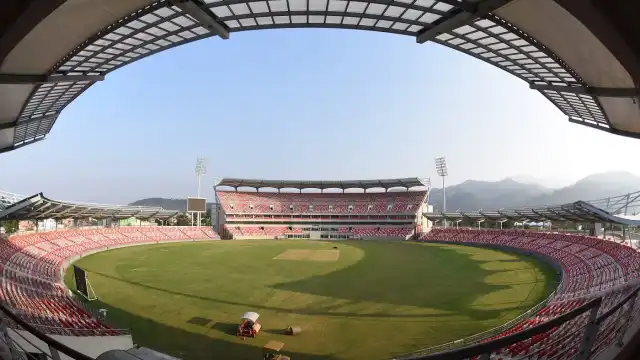
The stadium sits in Dehradun, Uttarakhand’s capital, within the undulating landscape of the Garhwal region. Unlike stadiums squeezed into dense city centres, this one was built with the surrounding hills as a deliberate design backdrop — the seating bowl was engineered to offer uninterrupted views of the playing field with the Himalayan foothills visible beyond it.
Reaching the stadium is manageable given Dehradun’s growing connectivity:
- By air: Jolly Grant Airport connects Dehradun to major Indian cities, with the stadium a reasonable drive from the terminal.
- By rail: Dehradun railway station links the city to Delhi and other northern hubs, making weekend match travel practical for fans across North India.
- By road: Dehradun’s expanding highway network, including improved connections to Delhi, has made the city considerably easier to reach by car in recent years.
How Many Spectators Can It Hold?
The stadium’s precast seating bowl accommodates up to 25,000 spectators, making it a mid-sized venue by Indian standards — smaller than giants like Ekana or the Shaheed Veer Narayan Singh Stadium, but sized appropriately for a state that’s still building out its cricketing infrastructure.
A few things worth knowing about its capacity and design:
- The seating bowl was built specifically to meet ICC guidelines, ensuring it can host Tests, ODIs, and T20Is at full international standard.
- It became India’s 51st international cricket venue and the 21st to host a T20I, a fast rise for a ground barely two years old at the time.
- The stadium is equipped for complete evacuation in under eight minutes, meeting international security benchmarks for venue safety.
Facilities Inside the Stadium
What genuinely sets this stadium apart is its blend of cricketing infrastructure with hospitality and cultural design touches rarely seen at Indian grounds of this size.
For spectators and guests:
- Restaurants, retail outlets, and banquet halls integrated directly into the stadium complex
- Corporate suites and lounges offering premium match-day viewing
- Triple-height atriums and bars for a more upscale spectator experience
- Conference rooms suited for corporate events and functions beyond match days
Architectural highlights:
- A tensile fabric and polycarbonate roof inspired by Aipan art, a traditional Uttarakhand folk art form
- Sandstone façades and double-glazed windows blending regional tradition with modern design
- LEED Gold certification, reflecting genuine sustainability commitments in construction and operations
Beyond cricket:
- A clubhouse complex featuring a 150-seat auditorium
- Guest rooms for visiting officials and dignitaries
- A bowling alley and indoor sports facilities, extending the venue’s use well past match days
What Makes This Stadium Distinctive?
Most Indian cricket stadiums prioritise raw capacity or historical pedigree. Dehradun’s venue took a different route, building cultural identity directly into its architecture rather than treating the stadium as a purely functional structure. The Aipan-inspired roof and sandstone detailing aren’t decorative afterthoughts — they’re central to how the building presents itself, giving Uttarakhand a sporting landmark that doubles as a piece of regional design storytelling.
Matches Hosted at the Stadium
Since its first international fixture in 2018, a T20I between Afghanistan and Bangladesh, the ground briefly served as Afghanistan’s home venue between 2013 and 2019 amid their displacement from regular home cricket. It hosted its only men’s Test in March 2019, an Afghanistan-Ireland fixture, alongside a string of ODIs and T20Is during that same window. Since 2018, it has functioned as the home ground for Uttarakhand’s domestic cricket team, giving the state’s players a genuine international-standard venue for Ranji Trophy and other domestic fixtures.
FAQs
Q1. Is Dehradun International Cricket Stadium the same as Rajiv Gandhi International Cricket Stadium?
Yes, both names refer to the same venue. Rajiv Gandhi International Cricket Stadium is the official name; Dehradun International Cricket Stadium is the commonly used alternative.
Q2. Which teams has this stadium hosted as a home ground?
Afghanistan used it as a temporary home venue between 2013 and 2019, while Uttarakhand’s domestic cricket team has played home matches here since 2018.
Q3. Does the stadium host IPL matches?
Current information does not confirm the stadium as a regular IPL venue; it’s primarily used for international fixtures and Uttarakhand’s domestic cricket matches.
Q4. What makes this stadium environmentally different from other Indian venues?
It holds LEED Gold certification, reflecting sustainable design choices in construction, materials, and operations, a distinction not commonly seen among Indian cricket stadiums.