Right in the middle of Connaught Place, a short walk from Rajiv Chowk, sits a stadium that most Delhiites pass without a second glance — yet Shivaji Stadium has quietly served as one of the capital’s key hockey venues for over half a century. Officially known as Shivaji Hockey Stadium, this NDMC-run facility has hosted everything from Commonwealth Games practice sessions to India’s women’s national hockey team training. Here’s a full look at where it stands, how big it is, and what it offers today.
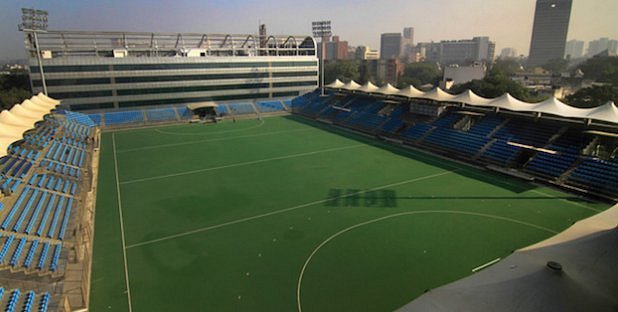
| Quick Facts | Details |
| Full name | Shivaji Hockey Stadium |
| Former name | Shivaji Stadium |
| Location | Connaught Place area, New Delhi |
| Owner/Operator | New Delhi Municipal Council (NDMC) |
| Built | 1964 |
| Rebuilt | 2008 |
| Capacity | Approx. 5,500–7,000 (sources vary) |
| Surface | Synthetic turf |
| Associated team | India women’s national field hockey team |
| Nearest metro | Shivaji Stadium (Airport Express Line), near Rajiv Chowk |
| Parking | Multi-level lot for approx. 1,500 vehicles |
Where Is Shivaji Stadium Located?
The stadium sits close to Connaught Place, right in the commercial heart of New Delhi — a location that puts it firmly among the most centrally placed sporting venues in the city. This isn’t a stadium tucked away on the outskirts; it’s walking distance from one of Delhi’s busiest hubs, which shapes both how the venue is used and how easily people can reach it.
Getting there is about as convenient as Delhi stadiums get:
- By metro: The Shivaji Stadium metro station on the Airport Express (Magenta) Line sits under a kilometre away, and Rajiv Chowk, one of Delhi Metro’s biggest interchange stations, is within easy walking distance too.
- By road: Baba Kharak Singh Marg runs close to the stadium, giving it strong connectivity to the wider Connaught Place road network.
- By air: Being on the Airport Express Line means visitors flying into Delhi have a fast, direct connection straight to the stadium’s doorstep.
How Many Spectators Can It Hold?
Reported capacity figures for Shivaji Stadium vary somewhat depending on the source — some list it around 5,500, others around 7,000. That range reflects the stadium’s scale accurately enough: it’s a mid-sized hockey venue, built for competitive matches and training rather than the tens of thousands seen at India’s major cricket grounds.
A few things worth understanding about its size and role:
- The stadium was originally selected to host hockey matches for the 2010 Commonwealth Games but wasn’t ready in time — its construction became one of the notable pre-Games controversies before the venue was eventually completed afterward.
- It has also hosted games for India’s UBA Pro Basketball League, showing the stadium’s flexibility beyond hockey alone.
- Despite its modest seating count compared to cricket or football stadiums, it functions as a serious competitive venue — club matches and lower-profile fixtures are regularly played here, keeping it consistently active through the year.
Facilities Inside the Stadium
The 2008 rebuild brought Shivaji Stadium up to a genuinely modern standard, and it’s held up well in the years since.
For players:
- Synthetic playing surface suited to competitive hockey
- Changing rooms and physiotherapy facilities on-site
- A five-storey facility centre built specifically for players, including change rooms, medical rooms, and a health club spread across the ground and first floors
For spectators and visitors:
- Multi-level parking accommodating around 1,500 vehicles — a genuinely large allowance for a stadium this size, useful given its central location
- Small underground retail spaces within the complex, adding a commercial dimension not typical of most sports venues
- A well-maintained, modern-contemporary design that visitors consistently note holds up against much larger, newer facilities
Institutional role:
- Long-associated with the India women’s national hockey team, which has used the stadium as a training and practice base
- Managed directly by the New Delhi Municipal Council, keeping it under consistent civic oversight rather than a private or sport-federation body
A Stadium With a Shifting Role
Shivaji Stadium’s story is really one of adaptation. Built in 1964, it served Delhi’s hockey community for decades before undergoing a full rebuild in 2008 ahead of the Commonwealth Games. Interestingly, plans changed along the way — it was originally meant to double as a practice venue for hockey and swimming, but that role eventually shifted to the Major Dhyan Chand National Stadium and the SPM Swimming Pool Complex instead. Despite that change in plans, Shivaji Stadium held onto its core identity as a home for India’s women’s hockey program and a reliable venue for club-level competition in the capital.
How It Compares to Delhi’s Other Hockey Venues
Delhi actually has more than one significant hockey stadium, and it helps to know where Shivaji fits. The Major Dhyan Chand National Stadium, with a much larger capacity of over 16,000, handles India’s bigger men’s hockey fixtures and international tournaments. Shivaji Stadium, by contrast, plays a steadier, lower-profile role — supporting women’s hockey, club matches, and other sporting fixtures that don’t need a massive crowd but still require a properly equipped, competition-standard ground. Together, the two venues give Delhi a genuinely well-rounded hockey infrastructure within just a few kilometres of each other.
FAQs
Q1. Is Shivaji Stadium used only for hockey?
Primarily, yes — it’s built and maintained as a hockey venue with synthetic turf, though it has also hosted basketball league matches, showing some flexibility beyond its core sport.
Q2. How is Shivaji Stadium different from Major Dhyan Chand National Stadium?
Shivaji Stadium is smaller and mainly supports women’s hockey, training, and club-level matches, while Major Dhyan Chand National Stadium is Delhi’s larger hockey venue for major men’s international tournaments.
Q3. How do I reach Shivaji Stadium by public transport?
The Shivaji Stadium metro station on the Airport Express Line is under a kilometre away, and Rajiv Chowk metro station is also within easy walking distance given the stadium’s central Connaught Place location.
Q4. Why wasn’t Shivaji Stadium ready for the 2010 Commonwealth Games as originally planned?
Construction delays around seating facilities meant the venue wasn’t completed in time for the Games, so hockey matches were shifted to other venues while Shivaji Stadium was finished afterward.