Talkatora Stadium doesn’t chase the spotlight the way Delhi’s bigger arenas do, but step inside and it’s clear why this indoor venue has held its ground for decades. Named after the Mughal-era Talkatora Gardens surrounding it, this stadium in the heart of the capital has hosted everything from Commonwealth Games boxing to national trade union gatherings. For anyone researching Delhi’s sporting infrastructure or planning a visit, here’s a complete picture of what the stadium offers.
| Quick Facts | Details |
| Full name | Talkatora Indoor Stadium |
| Location | Talkatora Garden, Chanakya Puri, New Delhi |
| Nearby landmark | Near Connaught Place and Ram Manohar Lohia Hospital |
| Owner/Operator | New Delhi Municipal Council (NDMC) |
| Capacity | 3,035 spectators |
| Total area | 12.13 acres |
| Built-up area | 3.7 acres |
| Primary sport | Boxing (also hosts badminton, wrestling, indoor events) |
| Major event hosted | 2010 Commonwealth Games (boxing) |
| Upgraded/reopened | 25 February 2010 |
| Attached facility | Talkatora Swimming Pool (Dr. S.P. Mukherjee Swimming Pool Complex) |
Where Is Talkatora Stadium Located?
The stadium sits in the Talkatora Garden area of New Delhi, close to Connaught Place and Ram Manohar Lohia Hospital. It takes its name directly from the surrounding Talkatora Gardens, a Mughal-era green space built around a tal — a tank or reservoir — set within a natural bowl-shaped depression formed by the Delhi ridge. That geography, a katora or bowl carved into hilly ground, is literally where the stadium gets its name.
Being centrally located has always worked in the stadium’s favour:
- It sits within easy reach of Central Delhi’s main government and diplomatic zones, making it convenient for both local residents and visiting officials or athletes.
- The Talkatora Swimming Pool, officially the Dr. S.P. Mukherjee Swimming Pool Complex, is part of the same complex, located a short distance away and functioning as a separate but connected facility.
- Public transport connectivity in this part of Delhi is strong, given its proximity to Connaught Place, one of the city’s busiest commercial and transit hubs.
How Many Spectators Can It Hold?
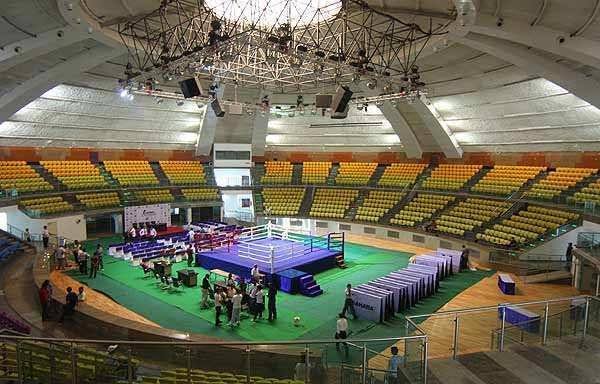
Talkatora Stadium has an official seating capacity of 3,035 people. That’s modest compared to Delhi’s outdoor arenas, but the stadium was never designed to compete on scale — it’s an indoor venue purpose-built for combat and precision sports, where sightlines and atmosphere matter more than sheer headcount.
A few things that stand out about its seating design:
- The layout was engineered so that every seat offers a reasonable view of the action, regardless of where you’re seated — a deliberate choice for a venue centred on boxing.
- Despite its compact size, the stadium has hosted crowds well beyond typical sporting capacity for non-sporting events; in 1978, more than 7,000 trade union delegates gathered here for a national session, which says something about how flexible the space can be for large indoor gatherings.
- The intimate scale actually works in favour of combat sports like boxing, where proximity to the ring enhances the spectator experience rather than diminishing it.
Facilities Inside the Stadium
The current stadium structure was inaugurated in February 2010 ahead of that year’s Commonwealth Games, and the upgrade brought it firmly into the category of a modern, purpose-built indoor arena.
For athletes and competition:
- One dedicated competition ring, purpose-built for boxing events
- Four separate warm-up areas for athletes preparing before their bouts
- A connecting tunnel linking the Facility Block to the main stadium, allowing athletes to move between training and competition spaces without stepping outside
Technical and spectator infrastructure:
- Acoustic ceiling design within the dome, improving sound quality for both commentary and crowd atmosphere
- Scoreboards and video screens for real-time match information
- Professional sports lighting suited for televised events
Sustainability features:
- Solar energy systems integrated into the stadium’s power setup
- LED lighting throughout, reducing overall energy consumption
- Underground utilities, including AC plants and water tanks, keeping the building’s environmental footprint compact given its footprint of just over 12 acres
Beyond sports:
- Two dedicated parking areas for spectators and event staff
- A layout that has supported everything from boxing championships to yoga camps, talent shows, and educational events over the years
A Venue With More Than One Identity
What makes Talkatora genuinely interesting is how much it has flexed beyond its original sporting purpose. Built initially with the 1982 Asian Games in mind and later upgraded for the 2010 Commonwealth Games, it has hosted international boxing and badminton alongside massive political gatherings and cultural events. Few indoor stadiums in Delhi can claim that kind of range — a venue equally comfortable hosting an Olympic-qualifying boxing bout and a room full of trade union delegates.
The adjoining swimming pool complex adds another layer entirely. While Talkatora itself focuses on combat and indoor sports, the SPM Swimming Pool Complex next door handles aquatics, giving the broader Talkatora Garden precinct a genuinely multi-sport identity within a single, walkable stretch of central Delhi.
Why Talkatora Still Matters Today
Delhi has no shortage of larger, flashier stadiums, but Talkatora holds a specific niche that those venues don’t cover as well: a compact, acoustically strong indoor space built specifically for combat sports and close-quarter spectating. For boxing in India, a sport that has produced serious Olympic and Commonwealth medal contenders in recent years, having a dedicated, well-equipped training and competition venue in the capital matters more than its modest 3,035-seat capacity might suggest.
FAQs
Q1. Is Talkatora Stadium only used for boxing?
No. While boxing is its primary sport and the reason it hosted the 2010 Commonwealth Games, the stadium has also held badminton and wrestling events, along with non-sporting functions like conferences and cultural programs.
Q2. Is the Talkatora Swimming Pool part of the same stadium?
The swimming pool, officially the Dr. S.P. Mukherjee Swimming Pool Complex, is a separate building within the same Talkatora Garden complex, located close to the main indoor stadium rather than inside it.
Q3. How do I reach Talkatora Stadium in Delhi?
It’s located in the Talkatora Garden area near Connaught Place and Ram Manohar Lohia Hospital, making it accessible via Delhi’s metro network and well served by local buses and cabs given its central location.
Q4. Why is the stadium’s capacity so much smaller than other Delhi stadiums?
It was purpose-built as an indoor combat-sports venue rather than a large-capacity outdoor arena, prioritising close sightlines and acoustics over the massive seating numbers typical of cricket or football stadiums.