Few cricket grounds in the world can compete on scenery alone, but Dharamshala manages it effortlessly. Tucked into the foothills of the Dhauladhar range in Himachal Pradesh, the HPCA Stadium isn’t just another venue on the IPL and international calendar — it’s the one fans specifically travel to see, snow-capped peaks and all. What began as a modest regional ground in 2003 has grown into one of the highest-altitude international cricket stadiums on the planet, hosting everything from Test matches to T20 World Cup fixtures. Here’s a complete look at where it stands, how big it is, and what awaits visitors inside.
| Quick Facts | Details |
| Full name | Himachal Pradesh Cricket Association Stadium |
| Commonly known as | HPCA Stadium / Dharamshala Stadium |
| Location | Dharamshala, Kangra district, Himachal Pradesh |
| Altitude | Approx. 1,457 metres (4,780 ft) above sea level |
| Established | 2003 |
| Seating capacity | 21,200–23,000 (figures vary by source) |
| Owner/Operator | Himachal Pradesh Cricket Association (HPCA) |
| Home teams | Himachal Pradesh men’s & women’s cricket teams |
| Secondary IPL home | Punjab Kings |
| First international match | 2013 (ODI, India vs England) |
| First Test | 2017 (India vs Australia) |
Where Exactly Is the Stadium Located?
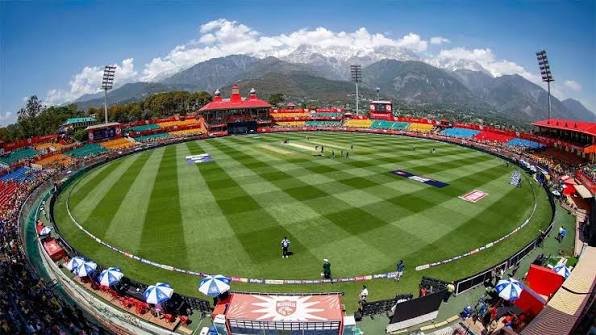
The ground sits in Dharamshala town, in Himachal Pradesh’s Kangra district, just a short drive below the popular hill station of McLeodganj. What sets this location apart from every other Indian venue isn’t the address on paper — it’s the backdrop. The stadium is built directly beneath the Dhauladhar mountain range, so on a clear day, spectators watch cricket with snow-covered peaks rising behind the far end of the ground.
This isn’t a low-lying coastal or plains venue either. At roughly 1,457 metres above sea level, HPCA Stadium ranks among the highest-altitude international cricket grounds anywhere in the world. That elevation isn’t just a geographic curiosity — it directly shapes weather conditions, air density, and even how the ball behaves off the pitch, something we’ll get to shortly.
Reaching Dharamshala takes a bit more planning than a metro-city venue:
- By air: Kangra Airport (Gaggal) is the nearest airstrip, roughly 15 km from the stadium, with limited but regular connectivity to Delhi and a few other cities.
- By road: Dharamshala connects to Chandigarh and Delhi via hill roads; the journey from Chandigarh typically takes 6–7 hours by car.
- By rail: The nearest broad-gauge railhead is Pathankot, from where road transport covers the remaining distance into the hills.
How Many Spectators Can It Hold?
Compared to giants like Eden Gardens or the Narendra Modi Stadium, HPCA is on the smaller side — and that’s part of its charm. Seating figures reported across official and media sources range between 21,200 and 23,000, with most current listings settling around 23,000. The exact number tends to shift slightly depending on how temporary stands are configured for a given series.
What the smaller capacity sacrifices in sheer scale, it makes up for in atmosphere. The stands sit close to the boundary, the layout is open on most sides, and mountain winds sweep straight across the field. That openness has a genuine cricketing effect too — fast bowlers get noticeably more assistance here than at most Indian venues, largely because of the thinner air at altitude combined with a pacier, harder pitch surface.
A few numbers worth knowing if you follow the stats:
- Highest Test total recorded here: 477 (India vs England, 2024)
- Highest ODI total: 388 (Australia vs New Zealand, 2023)
- Highest T20I total: 213 (South Africa vs India, 2025)
What Facilities Does the Stadium Offer?
HPCA was built to international standard from a fairly early stage, and over two decades of upgrades it has added the infrastructure expected of a modern venue while retaining its compact, scenic footprint.
For players and match officials:
- Modern dressing rooms and team facilities on both ends of the ground
- On-site gymnasium for player fitness and training
- Dedicated press boxes for media coverage during international fixtures
For spectators:
- Open, low-rise stands offering unobstructed mountain views from most seating tiers
- A layout designed to keep fans close to the boundary rather than set far back
- General accessibility improvements added progressively since the stadium’s early years
Beyond match days:
- The ground doubles as the home venue for Himachal Pradesh’s domestic men’s and women’s teams, so it sees regular use outside the international season
- Tibetan-inspired architectural touches in parts of the stadium complex, reflecting the region’s cultural identity
- The surrounding Kangra district offers visitors easy access to McLeodganj, Bhagsu Falls, and other hill-station attractions, making a stadium visit easy to combine with a short Himachal trip
Why the Pitch Plays Differently Here
Unlike most Indian venues, where spin dominates and slow, low pitches are the norm, Dharamshala flips the script. The high-altitude air and cooler climate produce a surface that offers early bounce and seam movement, giving fast bowlers a genuine advantage in the first several overs. As the match progresses and the pitch dries out under sunlight, conditions tend to flatten and turn more batting-friendly — a pattern experienced captains and analysts plan around during the toss.
International comparisons come up often in commentary, and not without reason: pundits regularly liken the seam-friendly, cooler conditions here to venues in England or South Africa rather than the typical subcontinental pitch. For a bowler-first start followed by a batting-friendly middle and death phase, Dharamshala is one of the more unpredictable venues on the Indian calendar — which is exactly why teams and broadcasters love scheduling marquee matches here.
Matches Hosted at HPCA Stadium
Since its first international fixture in 2013, the ground has built a genuinely varied résumé. It hosted its first Test in 2017 between India and Australia, and has since staged multiple ODIs, T20Is, and a steady stream of IPL matches as Punjab Kings’ secondary home venue. The stadium has also been selected as a venue for the upcoming ICC Men’s T20 World Cup, further cementing its status among India’s frontline international grounds — a considerable rise for a stadium that started out purely as a regional facility for Himachal’s own domestic cricket.
FAQs
Q1. Why does HPCA Stadium look so different from other Indian cricket grounds?
Its high-altitude setting beneath the Dhauladhar mountains gives it an open, low-rise stand design and a scenic backdrop that’s rare among Indian venues, most of which sit in flatter, more urban settings.
Q2. Is Dharamshala’s pitch good for batting or bowling?
It leans bowler-friendly early on, thanks to bounce and seam movement from the cooler, high-altitude air, but typically becomes easier for batting as the match progresses and the surface dries out.
Q3. How do I get to HPCA Stadium if I’m flying in from another city?
The nearest airport is Kangra Airport (Gaggal), about 15 km away, though flight options are limited — many visitors fly into Delhi or Chandigarh and complete the journey by road.
Q4. Which IPL team calls HPCA Stadium home?
Punjab Kings use it as their secondary home ground, in addition to Himachal Pradesh’s domestic men’s and women’s teams, who play there through the regular season.