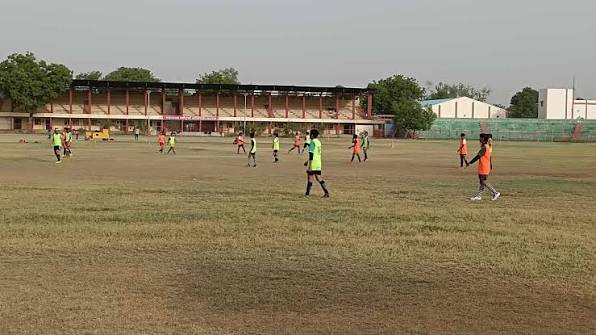
Eklavya Stadium Agra carries the name of Mahabharata’s most devoted archery student, and it’s lived up to that legacy in its own quiet way — training generations of young cricketers, hockey players, and athletes in the shadow of the Taj Mahal. Set up under Agra Municipal Corporation, this ground has hosted everything from Women’s World Cup cricket to a steady stream of domestic tournaments over the years. Here’s a complete look at its location, scale, and facilities.
| Quick Facts | Details |
| Name | Eklavya Sports Stadium |
| Location | Sadar Bazar, Agra Cantonment, Uttar Pradesh |
| Named after | Eklavya, the legendary archer from the Mahabharata |
| Owner/Operator | Agra Municipal Corporation |
| Seating capacity | 5,000 |
| Sports supported | Cricket, hockey, badminton, athletics |
| Notable event | Women’s ODI, 1997 World Cup (Netherlands vs West Indies) |
| Established | 1990 (current ground); earlier Sadar Bazar ground dates to 1934 |
Where Is Eklavya Stadium Located?
The stadium sits in Sadar Bazar, within Agra Cantonment, close to Idgah Colony — a well-established part of the city that’s been home to Agra’s sporting infrastructure for decades. Being inside the cantonment area gives it a certain civic permanence; this isn’t a facility that moves or gets displaced by urban redevelopment the way newer venues sometimes do.
Reaching the stadium is fairly convenient given its central-city position:
- By road: Its proximity to Agra’s Idgah bus stand makes it easily accessible from most parts of the city without requiring specialised transport.
- Within the city: Agra Cantonment is a well-connected zone, with local autos and cabs serving the Sadar Bazar area regularly throughout the day.
- By rail: Agra Cantt railway station, one of the city’s main rail hubs, sits close enough to make the stadium reachable for visitors arriving by train from Delhi or other nearby cities.
How Many Spectators Can It Hold?
Eklavya Stadium has an official seating capacity of 5,000, placing it firmly among Agra’s mid-sized sporting venues rather than its largest facilities. That capacity reflects its role as a genuinely functional community and domestic-level sports ground rather than a venue built to draw massive ticketed crowds.
A few things worth understanding about its scale:
- The ground was constructed with BCCI norms in mind specifically so it could host Ranji Trophy and other domestic first-class cricket matches.
- Floodlights installed at the venue allow it to host day-night fixtures, adding scheduling flexibility that many similarly sized grounds lack.
- Despite its modest capacity, the stadium becomes genuinely crowded during major tournaments, reflecting strong local interest in cricket and other sports hosted here.
Facilities Inside the Stadium
As an Agra Municipal Corporation facility, Eklavya Stadium has built out infrastructure supporting a genuinely wide range of sporting disciplines over the years.
Sporting infrastructure:
- A cricket ground built to BCCI standards, capable of hosting first-class domestic matches
- Facilities for hockey tournaments, alongside track and field event support
- Badminton courts available for both training and competitive play
Player and visitor amenities:
- Floodlights enabling evening and day-night match scheduling
- Air-conditioned changing rooms for players
- First aid facilities, drinking water points, and designated sitting areas for spectators
- Parking and general transportation access for match-day crowds
Community use:
- The ground has doubled as a fitness centre for local youth outside of formal match schedules
- It regularly hosts inter-school and inter-college tournaments alongside professional-level domestic fixtures
- Wheelchair accessibility and facilities for physically challenged visitors
A Name Rooted in Devotion and Discipline
The stadium’s name carries genuine cultural weight. Eklavya, from the Mahabharata, is remembered as the ultimate example of self-taught dedication — a tribal prince who mastered archery through sheer discipline after being denied formal training. Naming a sports facility after him is a fitting tribute, symbolising the same qualities of perseverance and self-driven excellence that youth athletes training here are meant to embody.
Cricket History at the Ground
Eklavya Stadium has a genuinely interesting cricketing past, split across two distinct chapters. Its predecessor ground, the original Sadar Bazar Stadium, dates back to 1934 and hosted 17 Ranji Trophy matches, including a memorable 1934 fixture where United Provinces bowled out Delhi for just 37 runs in the first innings. The current Eklavya Stadium, established in 1990, has continued that domestic cricket tradition, hosting matches in the Cooch Behar Trophy, Vijay Merchant Trophy, and CK Nayudu Trophy — all significant age-group and domestic tournaments in Indian cricket’s structure.
The stadium’s biggest moment on the international stage came in 1997, when it hosted a Women’s ODI between Netherlands and West Indies during the Hero Honda Women’s World Cup. Unfortunately, the match was abandoned with no play possible, but the fixture still marks Eklavya Stadium’s entry into India’s list of women’s international cricket venues.
Beyond Cricket: A Multi-Sport Hub
What distinguishes Eklavya Stadium from many single-purpose domestic cricket grounds is its genuine multi-sport identity. Alongside cricket, the venue regularly hosts hockey tournaments and track and field events, making it one of the more versatile sporting facilities in Agra. It’s also become a venue for cultural events, concerts, and school functions, extending its use well beyond the cricket season and giving Agra Municipal Corporation a genuinely multi-functional civic asset.
Local youth have used the facility as an informal fitness centre too, particularly outside major tournament windows, reflecting how deeply the ground has integrated into Agra’s daily community life rather than remaining purely an event venue.
How It Fits Into Agra’s Sporting Landscape
Agra’s sporting infrastructure includes a handful of notable venues beyond Eklavya Stadium, including the Tourist Bureau Stadium near Idgah Colony, which handles state-level and inter-city cricket matches. Together, these grounds give Agra — a city more commonly associated with the Taj Mahal than sporting fame — a genuinely functional domestic sports ecosystem. Eklavya Stadium’s blend of BCCI-standard cricket infrastructure, multi-sport facilities, and community accessibility makes it the more prominent of the two among serious domestic cricketers.
FAQs
Q1. Why is the stadium named after Eklavya?
It’s named after the legendary self-taught archer from the Mahabharata, symbolising discipline and dedication — qualities the venue aims to inspire in young athletes who train there.
Q2. Has Eklavya Stadium hosted any international cricket matches?
Yes, it hosted a Women’s ODI between Netherlands and West Indies during the 1997 World Cup, though the match was abandoned due to no play being possible.
Q3. What sports besides cricket are played at Eklavya Stadium?
The venue supports hockey, badminton, and athletics alongside cricket, making it one of Agra’s more versatile multi-sport facilities.
Q4. Does Eklavya Stadium host domestic cricket tournaments regularly?
Yes, it has hosted matches in the Cooch Behar Trophy, Vijay Merchant Trophy, and CK Nayudu Trophy, alongside regular club and inter-school cricket tournaments.