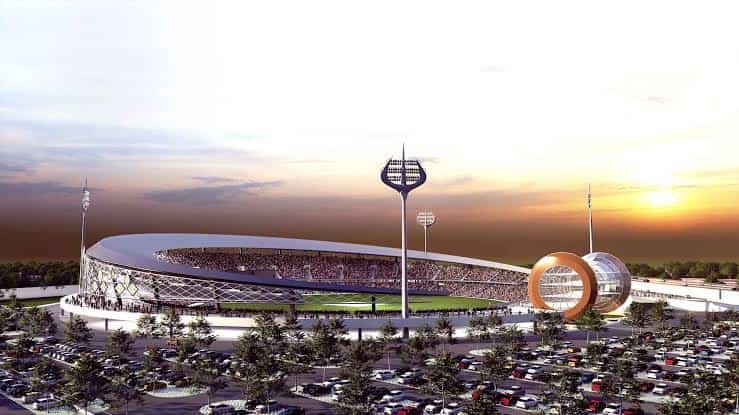
Varanasi International Cricket Stadium Varanasi draws its entire architectural language from Lord Shiva — crescent-shaped roof covers echoing his crescent moon, trident-shaped floodlights modelled on his trishul, and ghat-style seating steps recalling the very riverbank steps that define this ancient city. Prime Minister Narendra Modi laid the foundation stone for this ₹450 crore project in his own Lok Sabha constituency back in September 2023, and BCCI has since taken direct ownership of what promises to be one of India’s most culturally distinctive cricket venues.
Quick Facts: Varanasi International Cricket Stadium
| Detail | Information |
| Location | Ganjari, Rajatalab, Varanasi, Uttar Pradesh |
| Distance from city centre | Approximately 22 km |
| Land acquired | 30-30.6 acres, ₹121 crore |
| Foundation stone laid | 23 September 2023 |
| Construction cost | ₹330-450 crore |
| Contractor | Larsen & Toubro (30-year PPP operation) |
| Owner | Board of Control for Cricket in India (BCCI) |
| Governing body | Uttar Pradesh Cricket Association (UPCA) |
| Planned capacity | 30,000, expandable to 40,000 |
| Architect | M/s PLAN Architects, Mumbai |
| Design theme | Kashi Vishwanath temple and Lord Shiva motifs |
Locating the Stadium in Ganjari
The venue sits in Ganjari, within the Rajatalab area roughly 22 kilometres from Varanasi’s city centre, along the Varanasi-Jaunpur road beside Ring Road Phase-2. That location was chosen deliberately by the Uttar Pradesh government in 2023, giving the project genuine room to build a full 30-acre complex rather than squeezing an international-standard venue into the city’s dense, historic core.
Reaching the site involves a few practical considerations given its outskirts positioning:
- Varanasi sits directly on the mainline Delhi-Howrah railway route, giving the broader region strong rail connectivity for travellers.
- Lal Bahadur Shastri International Airport serves the city, keeping the stadium reasonably accessible for visitors flying in from across India.
- The 2021 redevelopment of the Kashi Vishwanath Corridor has already established Varanasi as a significant religious tourism hub, a factor that genuinely influenced the city’s selection for this stadium.
Understanding the Planned Capacity
The stadium’s planned seating capacity stands at 30,000, with expansion potential reaching 40,000 for major events — figures that have remained genuinely consistent across BCCI announcements, government sources, and independent tracking platforms since the project’s 2023 launch.
A few things worth understanding about its scale and current status:
- The venue is specifically designed as a full international-standard facility, positioned by BCCI as part of a broader push to distribute top-flight cricket beyond India’s traditional metropolitan hosting cities.
- Original completion targets ranged from December 2025 to before IPL 2026, though construction has faced delays pushing the timeline further into 2026.
- Once operational, this will become Uttar Pradesh’s third major international cricket stadium, joining Lucknow’s Ekana and Kanpur’s Green Park on the state’s international hosting circuit.
What the Stadium Will Offer
The Design Basis Report for Varanasi International Cricket Stadium lays out genuinely comprehensive infrastructure, blending international broadcasting standards with deep cultural symbolism.
- Nine practice wickets on the main ground, supporting extensive training and match preparation
- An advanced drainage system designed to minimise weather-related disruptions during matches
- A separate outdoor practice ground supplementing the main international arena
- Sufficient parking space accommodating large match-day crowds despite the venue’s outskirts location
- A VVIP and VIP zone positioned on the second floor of the South Pavilion
- Crescent-shaped roof covers, trident-shaped (“trishul”) floodlights, and drum-shaped (“damru”) architectural elements throughout the design
- Ghat-steps-inspired seating arrangements, directly referencing Varanasi’s iconic riverside steps
Why Varanasi, and Why This Design?
Understanding this stadium’s significance requires appreciating the deliberate cultural reasoning behind its location and design. BCCI’s selection process specifically emphasised cultural distinctiveness alongside international broadcasting standards, choosing Mumbai-based M/s PLAN Architects for a design that ties the venue directly to Kashi’s spiritual identity rather than following a generic modern stadium template. That approach reflects a genuinely different philosophy from most recently built Indian venues — rather than treating architecture as purely functional, the design team built the stadium’s entire visual identity around the city’s religious and cultural heritage.
A Foundation Ceremony With Genuine Cricketing Weight
The stadium’s 23 September 2024 foundation ceremony carried real significance within Indian cricket circles, drawing not just Prime Minister Modi but BCCI Secretary Jay Shah alongside cricketing legends Sunil Gavaskar, Ravi Shastri, and Dilip Vengsarkar. That level of attendance signals genuine institutional weight behind the project, positioning Varanasi’s new venue as a priority within BCCI’s broader infrastructure expansion plans rather than a routine regional stadium build.
BCCI’s Direct Ownership: A Notable Departure
What genuinely distinguishes this stadium from most Indian cricket venues is its ownership structure. Rather than following the typical model where state cricket associations own and operate their home grounds, BCCI itself holds direct ownership here, with Uttar Pradesh Cricket Association serving as the governing body once construction completes. That arrangement reflects BCCI’s increasingly hands-on approach to expanding India’s international cricket infrastructure into culturally significant cities beyond the traditional metropolitan circuit.
FAQs
Q1. Why is Varanasi International Cricket Stadium’s design inspired by Lord Shiva?
The architecture draws on Kashi’s spiritual identity as one of Hinduism’s holiest cities, incorporating crescent moon, trident, and drum motifs associated with Lord Shiva throughout the structural design.
Q2. When is the Varanasi stadium expected to be completed?
Original targets aimed for December 2025 or before IPL 2026, though construction delays have pushed the timeline further into 2026, with no confirmed new completion date.
Q3. Who owns and operates Varanasi International Cricket Stadium?
BCCI holds direct ownership, a departure from the typical state-association model, with Uttar Pradesh Cricket Association set to serve as the governing body once the venue opens.
Q4. How far is the stadium from Varanasi city centre?
The venue sits approximately 22 kilometres away in Ganjari, Rajatalab, along the Varanasi-Jaunpur road, requiring genuine travel time from the historic city core.