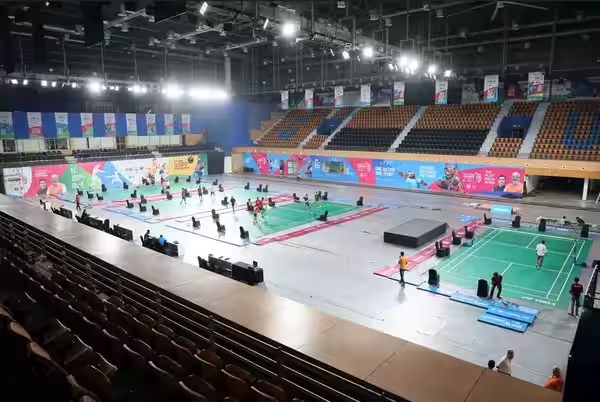
Dr Shyama Prasad Mukherjee Indoor Stadium sits on the Goa University campus in Taleigao, and it holds a genuinely unusual record — the longest single-sheet roof of any stadium in Asia, spanning 131 metres. Built for the 2014 Lusophony Games, this indoor arena was constructed in barely eleven months, a record for an international-standard facility of its kind. Here’s a complete breakdown of its location, capacity, and facilities.
| Quick Facts | Details |
| Name | Dr Shyama Prasad Mukherjee Indoor Stadium |
| Former name | Multipurpose Indoor Stadium |
| Location | Goa University campus, Taleigao, Goa |
| Owner/Operator | Sports Authority of Goa |
| Seating capacity | 4,000 |
| Flooring | Maple wood |
| Opened | 2014 |
| Construction cost | ₹82 crore |
| Construction time | 11 months |
| Roof feature | Asia’s longest single-sheet roof, 131 metres |
| Major event hosted | 2014 Lusophony Games (volleyball, basketball) |
Where Is Dr Shyama Prasad Mukherjee Indoor Stadium Located?
The stadium sits on the campus of Goa University in Taleigao, a coastal suburb close to Panaji, Goa’s capital. Being embedded within a university campus gives the venue a dual identity — it functions as a competitive sports facility for major tournaments while also serving as accessible infrastructure for the university’s own students and sporting programs.
Getting there is manageable given Taleigao’s proximity to Goa’s main urban centres:
- By road: The stadium sits within easy reach of Panaji, connected via Goa’s well-developed coastal road network.
- By air: Goa’s compact geography and airport connectivity mean visitors from other parts of India can reach the venue without extensive local travel.
- Within Taleigao: The university campus setting keeps parking and local access straightforward, without the traffic congestion that affects stadiums in denser urban centres.
How Many Spectators Can It Hold?
The stadium holds 4,000 spectators, placing it firmly among India’s mid-sized indoor arenas — smaller than venues like Pandit Deendayal Upadhyay Indoor Stadium in Surat (7,000) but comparable to several other state-run indoor facilities built around the same era, including Campal Indoor Complex elsewhere in Goa.
A few things worth understanding about its scale and construction:
- The stadium was built in just 11 months, a genuinely rare feat for an indoor facility meeting international competition standards.
- Its construction cost of ₹82 crore reflects the technical complexity involved, particularly the record-setting roof structure.
- Despite its relatively modest seating capacity, the venue was specifically engineered to host multinational competitive events, proven by its role in the 2014 Lusophony Games.
Facilities Inside the Stadium
Dr Shyama Prasad Mukherjee Indoor Stadium was built to genuinely international standards, and its facility list reflects that ambition.
For athletes:
- Specialised maple wood flooring designed to support multiple athletic disciplines, particularly volleyball and basketball
- Player change rooms and dedicated lounge areas
- Dope control and medical rooms, meeting standards required for international competitive events
For broadcast and events:
- A dedicated media centre supporting press coverage of major tournaments
- State-of-the-art acoustics engineered into the stadium’s design
- Bright, professional-grade lighting systems suited to televised competition
For spectators and visitors:
- Full air conditioning throughout the venue, a genuinely valuable feature given Goa’s tropical climate
- Ample parking facilities for both athletes and visiting spectators
- Wheelchair accessibility and standard visitor amenities including washrooms and drinking water points
The Roof That Made History
What sets this stadium apart architecturally is its roof — a single continuous sheet spanning 131 metres, making it the longest of its kind anywhere in Asia at the time of construction. This wasn’t purely a stylistic flourish; a long-span roof of this nature eliminates the need for internal support pillars across large sections of the arena, giving spectators unobstructed sightlines regardless of where they’re seated. Achieving this kind of span within an 11-month construction window is part of why the stadium’s build time remains a notable record in Indian sports infrastructure.
Named After a Significant Figure in Indian History
The stadium honours Dr Shyama Prasad Mukherjee, a prominent Indian politician and the founder of the Bharatiya Jana Sangh, a party that later evolved into the modern Bharatiya Janata Party. Naming state sporting infrastructure after prominent political and historical figures is a common practice across India, and this stadium’s naming reflects that broader tradition of tying civic landmarks to individuals who shaped the country’s political and social history.
A Venue Beyond Sport
Interestingly, this stadium has also made headlines for reasons entirely unrelated to competitive sport. It once hosted a record-setting construction demonstration, where a team of 21 workers built a 130-square-metre house in just 10.5 hours inside the venue — a feat that showcased rapid-construction techniques and drew national media attention. Events like this highlight how the stadium’s spacious, adaptable indoor space serves purposes well beyond its original sporting mandate, hosting exhibitions and demonstrations that need a large, controlled indoor environment.
What Sports and Events Does It Host?
Since opening in 2014, the stadium has primarily served volleyball and basketball, the two disciplines it was purpose-built for during the Lusophony Games. Beyond that founding event, it continues to serve as a regional and national tournament venue, drawing athletes and teams from across India for competitive fixtures. Its role within the Goa University campus also means it regularly supports university-level sporting events and training programs, keeping the facility active well beyond marquee international competitions.
FAQs
Q1. What makes Dr Shyama Prasad Mukherjee Indoor Stadium architecturally unique?
Its roof holds the record for Asia’s longest single-sheet span at 131 metres, eliminating internal support pillars and giving spectators unobstructed views throughout the arena.
Q2. Which sports does this stadium primarily host?
It was built for volleyball and basketball during the 2014 Lusophony Games and continues to host these sports, along with other indoor tournaments and university-level events.
Q3. Is the stadium located within Goa University itself?
Yes, it’s situated on the Goa University campus in Taleigao, giving it dual use as both a competitive venue and university sporting infrastructure.
Q4. Who manages Dr Shyama Prasad Mukherjee Indoor Stadium today?
The Sports Authority of Goa owns and operates the venue, overseeing its use for tournaments, university events, and other sporting or exhibition activities.