Dr D Y Patil Stadium Navi Mumbai opened its gates in March 2008 and immediately made history — it hosted that year’s inaugural IPL final, catapulting a stadium barely months old into the centre of Indian cricket’s biggest new tournament. Built inside Vijay Patil’s D Y Patil University campus in Nerul, this Hafeez Contractor-designed venue went on to earn the IPL governing council’s “Best Stadium Experience” recognition and, in early 2026, kicked off Women’s Premier League season four with Yo Yo Honey Singh and Jacqueline Fernandez performing at the opening ceremony.
Dr D Y Patil Stadium Navi Quick Facts
| Detail | Information |
| Full name | Dr. D. Y. Patil Sports Academy |
| Location | Nerul, Navi Mumbai, Maharashtra |
| Opened | 4 March 2008 |
| Architect | Hafeez Contractor |
| Owner | Dnyandeo Yashwantrao Patil |
| Operator | D Y Patil Sports Academy |
| Seating capacity | 45,300–55,000 (sources vary) |
| National ranking | Among India’s largest cricket stadiums |
| Ends | Media End, Pavilion End |
| Notable first | Hosted the inaugural 2008 IPL final |
Getting to the Stadium in Nerul
The stadium’s location roughly 50 km east of central Mumbai, inside the D Y Patil University campus, was a deliberate design choice rather than a limitation. Sitting outside the city’s crowded core gave planners genuine room to work with — enough that the complex even includes a small 12-wicket practice ground alongside the main stadium.
Getting there involves a few practical considerations:
- Nerul’s position within Navi Mumbai keeps the stadium connected to the city’s established suburban rail and road network, despite its distance from South Mumbai.
- The campus setting means parking and general access are considerably more spacious than at older, centrally located Mumbai venues.
- Visitors travelling from Mumbai proper should budget genuine travel time given the roughly 50 km distance, though Navi Mumbai’s own transport infrastructure has matured significantly since the stadium’s 2008 opening.
The Confusing Case of Two Capacity Numbers
Here’s something worth clearing up directly: sources disagree meaningfully on this stadium’s capacity, with some citing 45,300 and others insisting on 55,000. Both figures appear across genuinely reputable sources, including Wikipedia (45,300) and ESPNcricinfo (55,000), and the discrepancy doesn’t appear to be a simple typo — it likely reflects different counting methodologies or configuration changes over the stadium’s lifetime.
A few things worth understanding about its standing regardless of the exact figure:
- Even at the lower estimate, the stadium ranks among India’s ten largest cricket venues by capacity.
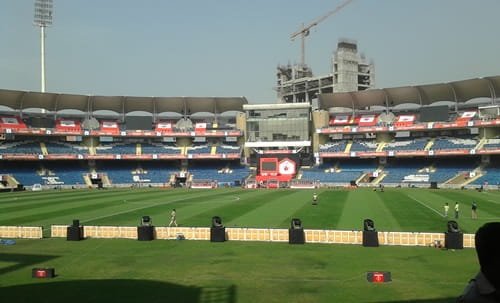
- The bucket-seat, cantilever gull-wing roof design eliminates support columns entirely, giving every single seat an unobstructed view of the field — a genuinely rare engineering achievement among Indian stadiums of this scale.
- The stadium earned recognition specifically for “Best Stadium Experience” from IPL’s governing council, an accolade tied directly to crowd flow, seating comfort, and hospitality standards rather than raw size.
Engineering and Facilities Built to Impress
D Y Patil Stadium was constructed with genuine ambition to stand apart from India’s older cricket grounds, and its facility list reflects that from the ground up.
- India’s first and largest fabric roof, made from material imported from Germany
- A full concert-level reinforced music system, making it the first sports stadium in the world with this feature built in from construction
- The country’s tallest floodlight masts, providing HDTV-ready lighting throughout the ground
- Permanent diesel generators ensuring uninterrupted power during matches, backed by a 500 KW solar plant covering over 70% of the stadium’s electricity needs
- An air-conditioned media centre with capacity for 120 people, alongside 60 private corporate boxes on the upper viewing level
- Nine tennis hard courts, four indoor badminton courts, and an Olympic-sized swimming pool within the broader academy complex
- 250 tonnes of clay imported from South Africa specifically for the playing surface
From Mumbai Indians’ Birthplace to a Multi-League Hub
When the IPL launched in 2008, D Y Patil Stadium became Mumbai Indians’ original home ground, hosting that year’s historic final and another in 2010 — instantly establishing Nerul as a genuine power centre in Indian cricket’s biggest commercial venture. Since then, the venue has hosted a genuinely diverse tenant list, including Deccan Chargers and Pune Warriors India during their respective IPL eras, alongside Mumbai City FC for select football fixtures.
The stadium’s role expanded significantly with the Women’s Premier League. In early 2026, it hosted WPL’s opening match — Royal Challengers Bengaluru versus defending champions Mumbai Indians — with accessible ticket pricing starting around ₹100, a decision that genuinely integrated women’s cricket into Navi Mumbai’s sporting culture rather than restricting it to elite audiences. That WPL leg ran through the Navi Mumbai fixtures before shifting to Vadodara’s BCA Stadium for the remaining matches and playoffs.
A Proving Ground for Major Tournaments
Ahead of the ICC Men’s T20 World Cup 2026, D Y Patil Stadium hosted high-profile warm-up fixtures including India versus South Africa and New Zealand versus USA, with India posting a dominant 240/6 that reinforced the ground’s reputation as a genuinely batting-friendly surface. Hosting international warm-up matches carries real significance for a venue’s standing — it signals both technical readiness and credibility with ICC and BCCI for future global tournament assignments, cementing D Y Patil’s status as more than just an IPL venue.
Reading the Pitch
The surface at D Y Patil Stadium is widely considered batting-friendly, particularly in limited-overs cricket, offering good pace and even bounce that rewards batters willing to play their shots once settled. A fast outfield further boosts scoring, favouring timing over sheer power, though fast bowlers can find some early assistance with the new ball during powerplay overs. Evening dew often plays a significant role too, generally making run-chases easier under lights.
FAQs
Q1. Why do capacity figures for D Y Patil Stadium vary so much across sources?
Reported figures range from 45,300 to 55,000 across different reputable sources, likely reflecting different counting methodologies or seating configuration changes over the stadium’s history since 2008.
Q2. Which IPL team originally called D Y Patil Stadium home?
Mumbai Indians used it as their original home ground starting in 2008, and the venue hosted both that year’s inaugural IPL final and the 2010 final.
Q3. Did D Y Patil Stadium host matches for the Women’s Premier League 2026?
Yes, it hosted WPL 2026’s opening match between Royal Challengers Bengaluru and Mumbai Indians, before the tournament shifted to Vadodara’s BCA Stadium for remaining fixtures.
Q4. What makes the stadium’s roof design unique among Indian venues?
It uses India’s first and largest fabric roof, imported from Germany, combined with a cantilever design that eliminates support columns for unobstructed views from every seat.